Tag: MULFOX

2D-heterostructure transfer system

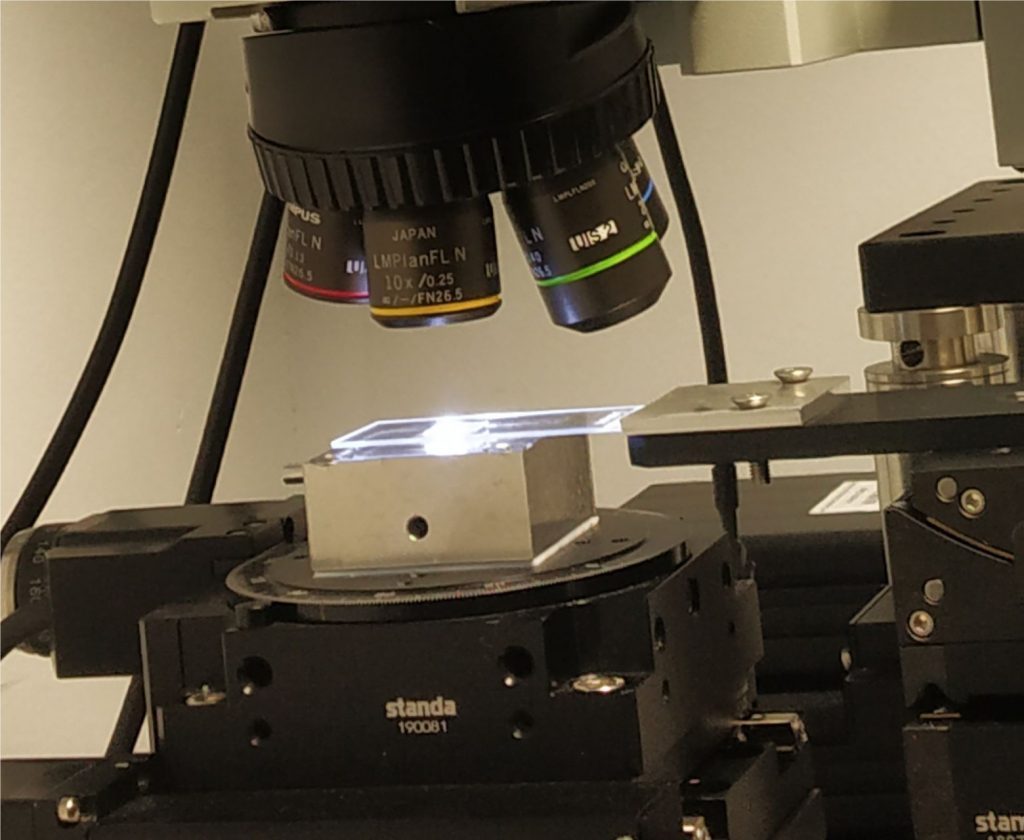
The 2D-heterostructure transfer system allows the transfer of exfoliated layered materials onto surfaces of various substrates and consists of fully motorized micro-manipulators with a total of 8 degrees of freedom and operate under a high resolution microscope with variable substrate temperature (from room temperature up to around 150ºC). The system includes:

  • Sample unit: Three degree of motion (Translation (x,y), Rotation (360º))
  • Transfer unit: Five degree of motion (Translation (x,y,z), Goniometer (x,y))
  • Microscope (DP23): High resolution microscope Long working distance objectives (5x, 10x, 20x, 50x)
  • Sample holder: equipped with temperature control (range RT-120oC) and vacuum hole for affixing sample. Goniometer control allow alignment of glass slide
Magneto-optic spectroscopy lab

The magneto-optic spectroscopy setup works from UV to near IR (wavelength range ~ 350 – 1000 nm). We carry out measurements of Kerr/Faraday rotation and ellipticity from 8 K up to 320 K, and with magnetic fields up to ~ 1.5 – 2 Tesla. The setup can work on different geometrical Kerr configurations (where we measure the light reflected from samples), including polar, longitudinal and transverse Kerr.

Wedge Wirebonder

We have a ultrasonic wedge bonder designed to interconnect micron-scale wire leads between samples holders and devices. The machine can bond aluminum or gold wires of ranging diameter (typically a few 10s of um).

Magneto-electric characterization

We have two electrical probe stations that allow us to measure longitudinal and transverse resistances in Hall bar devices using a lock-in technique. In the first station, DUTs are mounted on a motorized rotation stage and electrically connected using a wire bonder. The DUT can be rotated 360° in any given plane between the poles of an electromagnet producing fields up to 2.3 Teslas.

The second station uses the same measurement principles as the first one but the DUTs are contacted using microprobes and we are able to apply field along two axes simultaneously (in-plane 0.3 T and out-of-plane 0.05 T).  

Setups are complemented with a constant ac/dc current source, a pulse generator (1-100 ns, -/+50V), a high voltage source (<1.1 kV), an arbitrary waveform generator, and a high speed advanced oscilloscope. 

Magnetron Sputtering

We have a dual-chamber magnetron sputtering tool with dc and rf deposition capabilities. Chambers are dedicated to metal and oxide deposition, respectively, with a separate load lock chamber. We can deposit from two different targets simultaneously (co-deposition) in both chambers, and they can operate independently. Currently, the two chambers accommodate nine targets with a possibility of an upgrade up to seventeen. The oxide chamber has a gun for off-axis deposition, a unique feature to deposit stoichiometric films from multi-element targets. Reactive gases are also available (O2 and N2). The sample holder can rotate, be heated (up to 850°C), and apply a transverse magnetic field of 20 mT on the substrate during the deposition. Both chambers work at a base pressure in the low 10^8 Torr. 

Magneto-optical characterization

We have two Magneto-optic Kerr Effect (MOKE) setups operating in wide-field (WF) and scanning laser (SL) modes, respectively. WF-MOKE allows us to image magnetic domains in ultrathin (0.5-50 nm) ferromagnetic films with perpendicular magnetic anisotropy with resolution down to 1 um^2. It is equipped with a blue LED source and a high-speed/resolution camera to capture magnetization dynamics in (quasi-)real-time.

SL-MOKE operates with a focused laser in a selected range of wavelengths (405-632 nm) and can probe the out-of-plane magnetization orientation locally (~1 um^2). The sample is mounted on a motorized x-y translation stage, which allows scanning the sample with high precision and mapping the magnetization orientation over a larger area (e.g., 30×30 um^2).

FErroelectric and DiElectric

Our FErroelectric/DiElectric laboratory is specially designed to characterize all kind of functional properties of ferroelectric and multiferroic thin films

Laboratory lead and designed by Dr. Ignasi Fina

The following characterizations can be performed:

All these characterizations can be implemented in three experimental setups, to perform respectively room temperature, high and low temperature, or cryogenic magnetoelectric measurements:
  1.  Room temperature measurements: a table with micropositioners (Signatone S-2 and S-725) and tungsten needles of several diameters and hardnesses is used. A Faraday box is available to shield environmental noise when required.
  2. Low and high-temperature probe station: a 4-probes station able to reach from down to 5 K to ca. 1000 K with access to laser illumination.
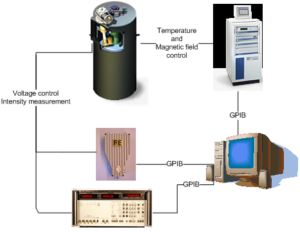
  3. Cryogenic measurements (T>1.6K): they are performed inside a Physical Property Measurement System Quantum Design Co.) with a Multifunction probe suitably adapted (shielded cables with low thermal losses: Cryo cable – type SS, Lakeshore Co.). This system contains a superconducting magnet which allows to carry out all the electric measurements under magnetic fields up to 9T, thus allowing magnetoelectric characterization under high magnetic field.
You can have access to this facility through the nffa.eu project